

When I say I go to undiscovered areas when I travel, most people don't picture a hospital waiting room.
Due to a chronic digestive condition, I've developed an embarrassing pattern across my years of traveling through Latin America. I eat something I shouldn't, and I almost always do, because I can never say no to a novel dish, to the thing the locals are eating.
Somewhere between the thrill of discovery and the cold sweat that follows, I would end up facing a choice — public hospital or private clinic. It sounds logistical. It isn't. I've faced this choice in Guatemala, Colombia, Costa Rica, Brazil, El Salvador, and Mexico. Each time the culprit of my suffering changes, the choice stays structurally identical: two doors, both of which cost you something, the question being only what you can afford to lose.
Between Public and Private
The first time I chose public, I was in Mexico City at 2am, sick enough that the taxi ride felt like something that was happening to someone else. I arrived at the Hospital General Dr. Eduardo Liceaga, one of the largest hospitals in Mexico City, a stocky building made of reflective glass. A security guard took my symptoms at the gate, printed a number on a flimsy paper slip warm from the machine, and waved me through without looking up.
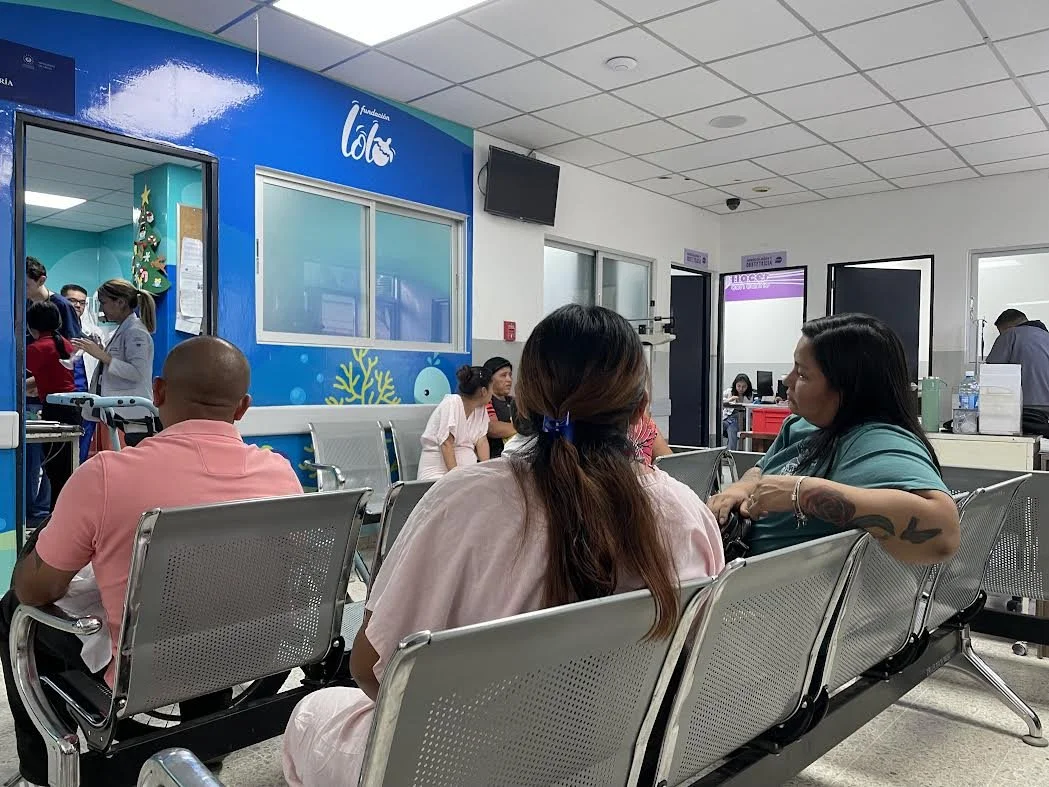
I heard the waiting room before I saw it: a mix between groans and winces, the squeaky sound that shoes make against cheap tiles, and an ambient beeping that came from deep in the hospital. There were a few elderly people who lay on stretchers along the walls, their bodies arranged in the particular stillness of people who had surrendered to waiting. A man near the entrance had his burn dressings changed, the old gauze coming away dark. Every plastic seat was occupied. Patients spread onto the floor in the gaps between chairs, sitting with their backs against the wall, their belongings pulled into their laps, their gazes trying not to land on another person who is suffering.
I looked for someone to ask about wait times and found no one, not because the staff weren't there, but because the scale of need had made individual attention structurally impossible. I left, found a second public hospital nearby, stood at its entrance long enough to understand it was the same, and got back in an Uber. Leaving took less than a minute and cost me nothing.
However, as I left, I thought about how the people arranged on that floor were not there by preference. They were there because the door I was about to walk through did not exist for them.
I found a private clinic on Google Maps, a place with all five-star reviews. I arrived at a locked glass door with a brass buzzer, and realized that it was the kind of place whose clients find it when they need it because an entire infrastructure of hotel concierges, expat forums, and word of mouth exists to ensure they do.
I pressed the buzzer. Someone appeared almost immediately, materializing behind the glass with the quiet efficiency of someone waiting, specifically, for me.
The inside smelled good — a scent that suggested medical-grade cleanliness. The floors were white, the walls were white, a small vase of fresh flowers sat on the receptionist’s desk. A receptionist took my information in careful, accented English and told me the doctor would be right with me. He was. The examination room was immaculate in the way only lightly-trafficked rooms are: the paper on the table uncreased, and the instruments gleaming with the shine of things sterilized more times than they've been used. Within minutes, I had an IV line in my arm pushing fluids through me while I gradually felt more energized.
The private clinics produced a different type of anxiety, the kind that comes from knowing every interaction had a cost. The doctor ordered a blood test. Was that included? The nurse brought a second IV bag. Would that appear on the bill? By the time my $250 bill arrived, I had already spent two hours constructing and revising estimates in my head.
Guatemala, it turned out, presented a third option.
A Third Option
I was in Guatemala City, three days from a planned trip to the famous ruins of Tikal, when the illness came on worse than it ever had. I couldn't stand upright for more than a few minutes without the room tilting.
Guatemala spends 2.6% of its GDP on healthcare, among the lowest rates in Central America, with roughly one physician for every thousand patients. Its constitution commits to providing free public healthcare to everyone who walks through the door, citizens and foreigners alike.
The public hospital in Guatemala City was large, but the staff moved me through quickly. A doctor in the triage room pressed on my stomach, nodded with the recognition of someone who has seen this a thousand times, and told me I had a stomach infection. A tablet of antibiotics was waiting for me at the pharmacy window two minutes later.
I went to the front desk to pay.
The woman behind the counter did not look up. I told her I was ready to settle the bill.
"No," she said. "You don't pay."
I assumed there must have been a misunderstanding. "I'm a foreigner,” I explained, "I'm not from Guatemala."
She looked up briefly, with the expression of someone explaining something obvious to someone making it complicated. "Same," she said, and waved me away, already looking back down.
The two-tier system I moved through across six countries, packed public wards and gleaming private clinics, is not a symptom of underdevelopment. The wealthiest country in the world made the same choice more aggressively than anyone: the United States spent $14,885 per person on healthcare in 2024, the highest of any country in the world, but a third of working-age adults skip or delay getting the medical care they need because they cannot afford it.
Guatemala, with a GDP per capita of $6,150, is the poorest country I visited by a significant margin. Brazil sits at $10,310, Chile at $16,709, and Argentina near $14,000. Every one of them built the same two-tier system: public wards for those with no other option, private clinics for those who could pay to avoid them. Guatemala, the one country that could least afford generosity by any economic measure, was the one that extended it without condition.
Guatemala's system is not a model. Its hospitals are underfunded and its rural coverage thin. But it established, at the level of law, that the two waiting rooms are not the only option.
*The opinions of contributing writers are their own and do not necessarily represent the views of We Are One Humanity. Submissions offering differing or alternative views are welcome


