

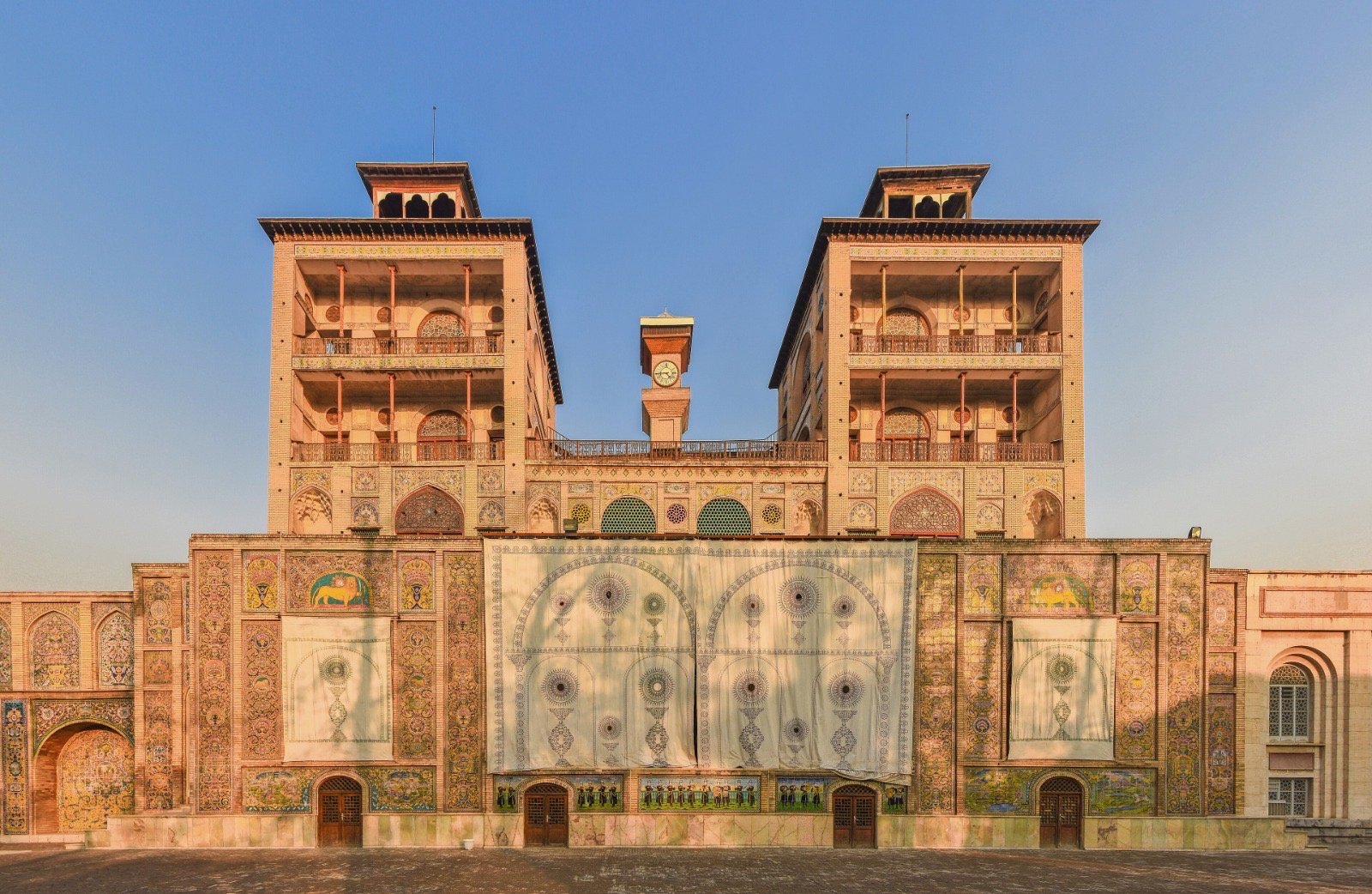
Last week, images of a Golestan Palace damaged by airstrikes in Tehran, Iran, circulated on social media. Glass shards were scattered across marble floors. Chandeliers wrapped in protective cloth by Iranian cultural officials weeks before the bombs fell, their light extinguished anyway by shockwave. The Mirror Hall, which Nasser al-Din Shah modeled on Versailles after his 1889 visit to Paris, was reduced to a room of bent wooden frames and open sky where the windows had been. Golestan Palace, four centuries old, the seat of the Qajar dynasty, and Tehran's only UNESCO World Heritage Site, was unrecognizable from its past splendor.
The next day, condemnations arrived from UNESCO, historians and the U.N. Secretary General Antonio Guterres. Outrage spread on social media. X users called the strike a “crime against humanity” and said there were “no words for my sadness.” Redditors lamented that it was “another useless war that destroys beauty” and “sad loss of history and craftsmanship”.
The mourning was not confined to the West. On RedNote, Chinese tourists who had stood in those halls posted their own photographs alongside the rubble. “I've been there... it is so tragic to watch a beautiful thing being destroyed in front of your eyes,” commented one poster. The top comment on another post reads “whoever destroys world heritage is the world’s gravest sinner.”
On the same day that news about Golestan broket, the Iranian Red Crescent Society also confirmed that at least 787 Iranians have been killed since the US-Israeli attacks on Iran began. While there were reactions to this across the world — notably the girls' school bombing in Minab, which killed over 160 children and briefly became a flashpoint in diaspora communities and human rights circles — no hashtag carried their names across the political divides that the palace images crossed without effort.
‘Just a Site’
Iranians did not always share the global sentiment about the building.
Mana Tadayon, 28, who grew up in Tehran and moved to the US eight years ago, said the dominant sentiment among Iranians to Golestan’s destruction was one of pragmatism rather than grief.
"This is just a site," she said, relaying what she had heard from other Iranians, including relatives who fled Tehran to northern Iran when the strikes began. "There are other important things we need to focus on right now."
Many Iranians in the diaspora, she explained, had spent years watching their government slaughter its own people without a meaningful international response, with over 5,000 confirmed dead in the January crackdown against Iranian protestors. Against that context, the global outcry over a damaged mirror hall read less as solidarity than as a reminder of a longer silence.
"They always say: our regime has been slaughtering people for decades and it doesn't get the global recognition it needs," she said. "Why won't people care about our cause?"
The Abstraction of Mass Casualties
In a war where hundreds have died, how did damage to a palace become the emblem of loss in Iran?
The first reason is that we have more cultural context for buildings than we do for people. Golestan has a UNESCO World Heritage designation. It appears in Islamic art history courses at universities. Christiane Gruber, a professor at the University of Michigan who has worked inside the palace, describes its collection as containing one of the world's most important archives of Islamic manuscripts. It makes itself known on travel bucket lists: the Chinese tourists mourning on RedNote this week had stood in those mirror halls, photographed that tilework, and now recognized the rubble.
The second reason is that we grieve things more when we see them as irreplaceable. Golestan is one building, unique by definition. But a death toll is a number that grows, and as it grows, the individual disappears into the count. We cannot make sense of the difference between 786 and 787. The abstraction of mass casualties makes individual lives feel, wrongly, like they are part of a renewable resource. What we tend to overlook is that each of those lives contains what we prize in the palace — a singular accumulation of experience, memory, and history that, once gone, is also gone forever. The tragedy is compounded by ignorance: we lacked the education, the exposure, and the cultural context that would have allowed us to recognize these people as irreplaceable before they were gone.
This asymmetry is not new. When the Taliban dynamited the Bamiyan Buddhas in March 2001, the UN General Assembly convened an emergency session, and UNESCO sent 36 letters of objection. The Metropolitan Museum of Art offered to fund a team to travel to Afghanistan to salvage portable artifacts — a gesture the Taliban rejected, noting that no such resources had been offered to feed Afghan children.
‘People’s Lives Are More Important’
Last week, a Tehran nurse named Morteza Hamedi, speaking from inside the bombardment, put it plainly: "Yes, the palace is important, but right now the lives of people are more important." Each of those people carries something as irreplaceable as Golestan's shattered orosi window: testimony, memory, the specific experience of a city under sustained bombardment from over 5,000 strike targets. That specific history contained in individuals and families is at risk of being lost, and is just as constitutive of what Iranian civilization will mean to whoever comes next.
Iran has formally requested that UNESCO send a delegation. What gets restored under the 1954 Hague Convention for the Protection of Cultural Property is stone, glass, and wood.
The palace will have restorers. The people who died will not. The convention does not offer a way to document and preserve the testimony of Morteza Hamedi, the Tehran nurse who watched this week's strikes and noted, with some impatience, that his colleagues were still talking about the palace while people were dying in the wards.
*The opinions of contributing writers are their own and do not necessarily represent the views of We Are One Humanity. Submissions offering differing or alternative views are welcome.


